Problem:
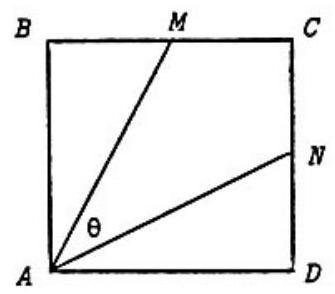
A B C D A B C DA B C D is a square and M MM and N NN are the midpoints of B C B CB C and C D C DC D respectively. Then sin β‘ ΞΈ = \sin \theta=sin ΞΈ =
Answer Choices:
A. 5 5 \dfrac{\sqrt{5}}{5}5 5 β β
B. 3 5 \dfrac{3}{5}5 3 β
C. 10 5 \dfrac{\sqrt{10}}{5}5 1 0 β β
D. 4 5 \dfrac{4}{5}5 4 β
E. none of these answers
Solution:
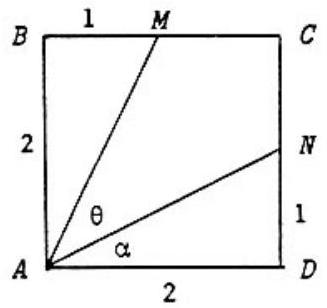
We may suppose that the sides of the square have length 2 22 , so that B M = N D = 1 B M=N D=1B M = N D = 1 . Then
sin β‘ ΞΈ = sin β‘ ( Ο 2 β 2 Ξ± ) = cos β‘ 2 Ξ± = 2 2 Ξ± β 1 = 2 ( 2 5 ) 2 β 1 = 3 5 \begin{aligned}
\sin \theta & =\sin \left(\dfrac{\pi}{2}-2 \alpha\right)=\cos 2 \alpha \\
& =2 \cos ^{2} \alpha-1 \\
& =2\left(\dfrac{2}{\sqrt{5}}\right)^{2}-1 \\
& =\dfrac{3}{5}
\end{aligned}
sin ΞΈ β = sin ( 2 Ο β β 2 Ξ± ) = cos 2 Ξ± = 2 cos 2 Ξ± β 1 = 2 ( 5 β 2 β ) 2 β 1 = 5 3 β β
Alternately, one may express Area β³ A M N \triangle A M Nβ³ A M N in terms of sin β‘ ΞΈ \sin \thetasin ΞΈ , find Area β³ A M N \triangle A M Nβ³ A M N again numerically by subtracting the areas of other (right) triangles from the area of the square, and then solve for sin β‘ ΞΈ \sin \thetasin ΞΈ .