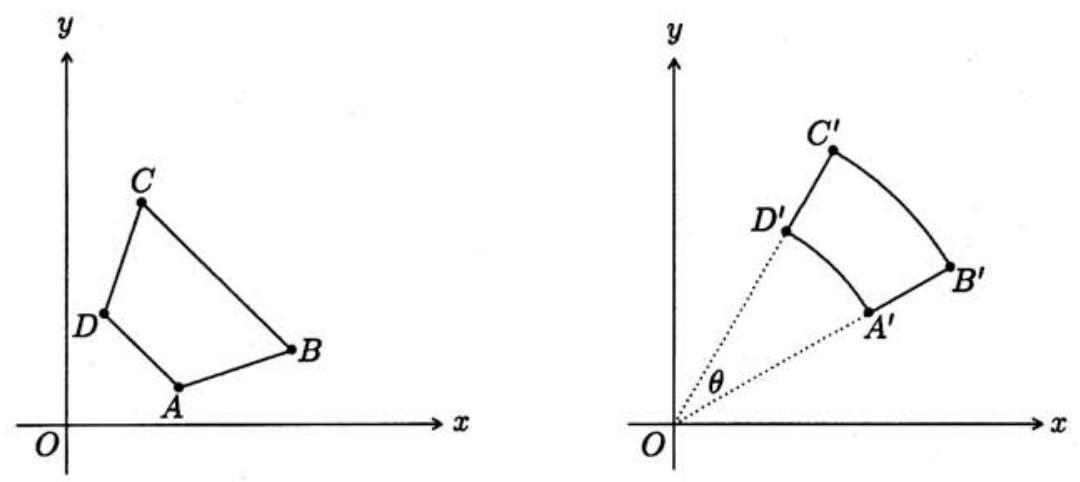
Problem:
A transformation of the first quadrant of the coordinate plane maps each point (x,y) to the point (x,y). The vertices of quadrilateral ABCD are A=(900,300), B=(1800,600),C=(600,1800), and D=(300,900). Let k be the area of the region enclosed by the image of quadrilateral ABCD. Find the greatest integer that does not exceed k.
Solution:
Notice that AB is contained in the line whose equation is 3y=x. The image of a point on AB must therefore satisfy 3y2=x2. Because the coordinates of the image points must be positive, the image A′B′ of AB is contained in the line y3=x. In a similar fashion, it follows that the image C′D′ of CD is contained in the line y=x3. An equation for line AD is x+y=1200, so the image of AD is contained in the first-quadrant part of the circle x2+y2=1200. In a similar fashion, it follows that the image of BC is contained in the first-quadrant part of the circle x2+y2=2400. Thus the area of the region enclosed by the image of quadrilateral ABCD is 360θ(π(OB′)2−π(OA′)2), where O is the origin and θ is the degree measure of the angle formed by OA′ and OD′. Notice that θ=tan−13−tan−131=30, because the slope of OD′ is 3 and the slope of OA′ is 31. Hence the area of the region enclosed by the image of ABCD is k=121(2400−1200)π=100π, and the greatest integer that does not exceed k is 314.