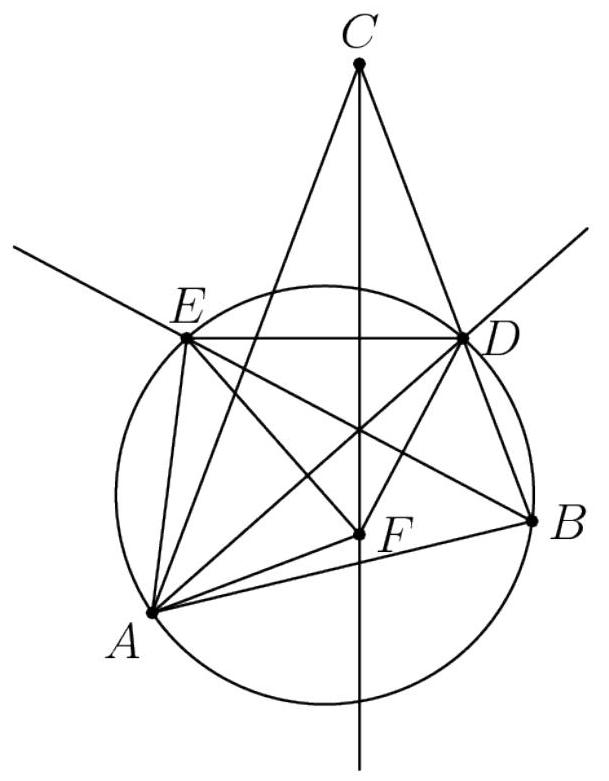
Problem:
Point D lies on side BC of △ABC so that AD bisects ∠BAC. The perpendicular bisector of AD intersects the bisectors of ∠ABC and ∠ACB in points E and F, respectively. Given that AB=4,BC=5, and CA=6, the area of △AEF can be written as pmn, where m and p are relatively prime positive integers, and n is a positive integer not divisible by the square of any prime. Find m+n+p.
Solution:
Denote MA,MB,MC to be the midpoints of the arc BC, CA, AB.
Notice by the incenter excenter lemma, that IMA=MAB=MAC.
Then, using Ptolemy's on ABCMA yields
BC⋅AMA=AB⋅CMA+AC⋅MAB
This yields that 2MAI=MAA→MAI=IA
Notice that
DMADI=BMAsin∠CBMABIsin∠IBC
which can be simplified to
DMADI=BMAsin2∠ABIsin2∠B=1
And so D is a midpoint of IMA.
Since AI gets perpendicularly bisected by MBMC, and AD is perpendicularly bisected by EF, and that D is a midpoint of AI, we see that there's a homothety of DEF and ABC with ratio 21 around I.
This means that [AEF]=[DEF]=(21)2MAMBMC.
We can find the circumradius that R=787.
Notice the area of a triangle can be written as
[ABC]=4Rabc
Rewriting
R=sinAa=sinBb=sinCc
or
a=RsinA,b=RsinB,c=RsinC
This yields that
[ABC]=2R2sinAsinBsinC
and we can calculate these values using law of cosines and then using sin2θ+cos2θ=1
We get that the area of MAMBMC is 7307 and thus [AEF]=41[MAMBMC]=14157.
OLD SOLUTION
Let x=∠BAD=∠CAD,y=∠CBE=∠ABE, and z=∠BCF=∠ACF. Notice that x+y+z=90∘. In △ABD, segment BE is the bisector of ∠ABD, and E lies on the perpendicular bisector of side AD. Therefore E is the midpoint of arc AD on the circumcircle of △ABD. It follows that ∠BED=∠BAD=x and ∠EDA=∠EBA=y. Likewise, ACDF is cyclic, ∠CFD=∠CAD=x, and ∠FDA=∠FCA=z. Because EF is the perpendicular bisector of AD, triangles AEF and DEF are congruent, implying that