Problem:
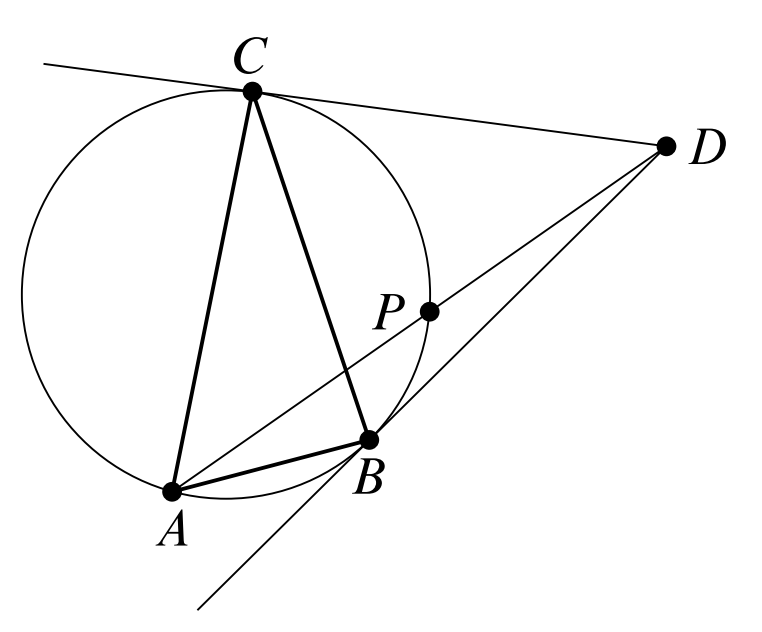
Let △ABC have side lengths AB=5,BC=9, and CA=10. The tangents to the circumcircle of △ABC at B and C intersect at point D, and AD intersects the circumcircle at P=A. The length of AP is equal to nm, where m and n are relatively prime positive integers. Find m+n.
Solution:
Note that ∠DBP=∠DAB and ∠DCP=∠DAC because the two pairs of angles subtend arcs BP and CP, respectively. It follows that △DBP∼△DAB and △DCP∼△DAC.
Then
BPAB=BDAD=CDAD=CPAC.
Because AB=5 and AC=10, it follows that CP=2⋅BP. Let y=BP; then CP=2y. Applying Ptolemy's Theorem to cyclic quadrilateral ABPC yields
BC⋅AP9⋅APAP=AB⋅CP+AC⋅BP=20y=920y.(1)
The problem thus reduces to finding y. Applying the Law of Cosines to △BPC yields
Quadrilateral ABPC is cyclic, implying that ∠BPC=180∘−∠BAC, so cos(∠BPC)=−cos(∠BAC). Applying the Law of Cosines to △BAC yields
cos(∠BAC)=2⋅5⋅1052+102−92=2511.
Substituting this into (2) yields
5y2+2544y2=81⟹y=1345.
Substituting this value into (1) yields
AP=920⋅1345=13100.
The requested sum is 100+13=113.
OR
Let T be the transformation of the plane that consists of an inversion of the plane with respect to the circle with center A and radius AB⋅AC followed by a reflection of the plane across the angle bisector of ∠BAC. Note that T is an involution, that is, it is its own inverse. Then T(B)=C and T(C)=B. Line BC goes to a circle ω passing through A, T(B), and T(C), so it is the circumcircle of △ABC. Thus T(BC)=ω and T(ω)=BC. Line BD is tangent to ω, so T(BD) is a circle passing through A and C and is tangent to line BC. Similarly, T(CD) is a circle passing through A and B and is tangent to line BC. Hence T(D)=D′ is the second intersection of the above circles. Line AD′ is the radical axis of the two circles, and line BC is tangent to both circles. Therefore AD′ intersects BC at M, where
MC2=MD′⋅MA=MB2,
implying that M is the midpoint of BC. Thus T(P)=T(ω∩AD)=T(ω)∩T(AD)=BC∩AD′=M. This implies that AP⋅AM=AB⋅AC. Because M is the midpoint of BC, the distance AM can be found using the Length of Median Formula:
AM=21⋅2⋅AB2+2⋅AC2−BC2=21⋅2⋅52+2⋅102−92=213.
Then
AP=AMAB⋅AC=2135⋅10=13100,
as above.
OR
As in the first solution, BPAB=CPAC. Let M be the midpoint of BC. Applying the Law of Sines to △AMB and △AMC yields
Therefore cot(∠CAM)=cot(∠PAB) and ∠CAM=∠PAB. Because ∠ACB=∠APB, it follows that △CAM∼△PAB, and AP⋅AM=AB⋅AC. The remainder follows as in the second solution.