Problem:
Let △ABC have incenter I, circumcenter O, inradius 6, and circumradius 13. Suppose that IA⊥OI. Find AB⋅AC.
Solution:
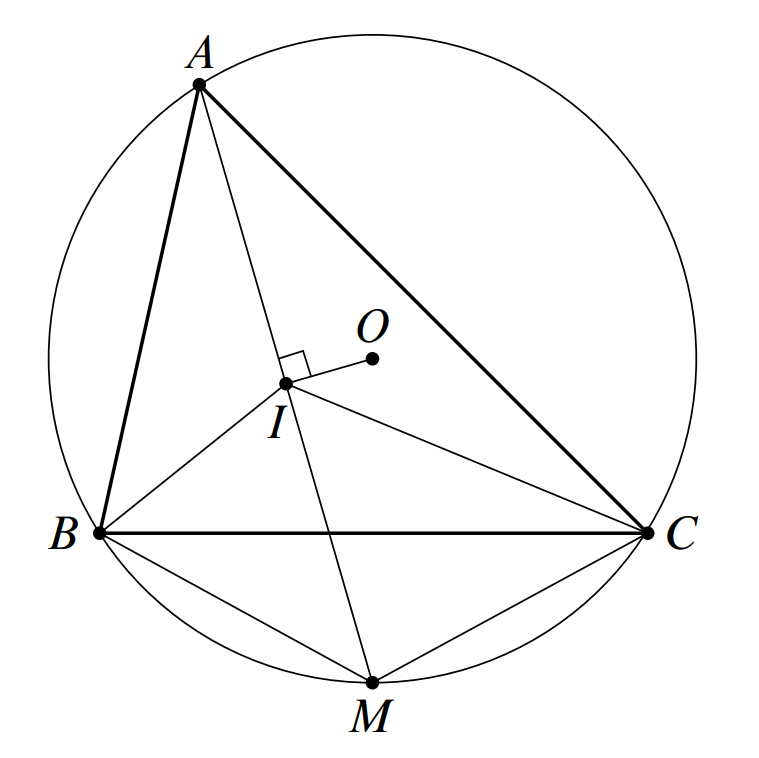
Extend AI to meet the circumcircle at M.
Because AI⊥OI, it follows that I is the midpoint of AM. Note that BM=CM because line AM is a bisector of angle ∠A. In addition, ∠BIM=∠IBM=2∠A+∠B, and thus BM=CM=IM=AI. Applying Ptolemy's Theorem to cyclic quadrilateral ABMC and using BM=CM=21⋅AM gives AM⋅BC=AB⋅CM+AC⋅BM=21⋅AM⋅(AB+AC), so BC=2AB+AC.
Expressing the area of triangle ΔABC in two different ways gives
Area(ΔABC)=21(AB+AC+BC)r=23⋅BC⋅r, and
Area(ΔABC)=4RAB⋅AC⋅BC.
It follows that AB⋅AC=6⋅R⋅r=6⋅6⋅13=468.
OR
Because the inradius is r=6 and the circumradius is R=AO=13, it follows from Euler's Formula for the distance from the incenter to the circumcenter that OI2=R2−2⋅r⋅R=132−2⋅6⋅13=13. Then applying the Pythagorean Theorem to ΔAIO gives AI=AO2−OI2=132−13=156=239.
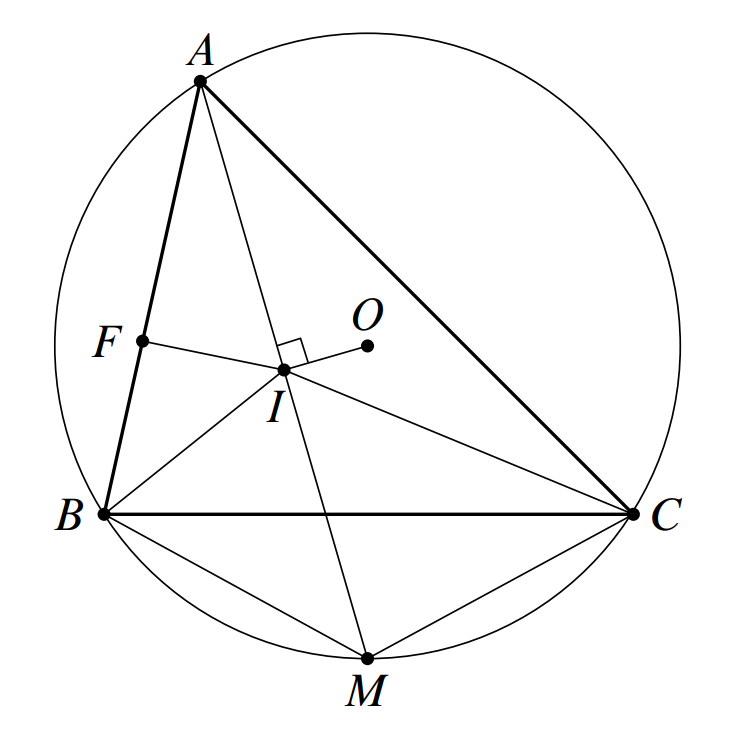
Let F be the projection of I onto AB and note that IF=r=6, so applying the Pythagorean Theorem to ΔAIF gives AF=AI2−IF2=156−62=120=230. Then
so by the Extended Law of Sines, it follows that BC=2Rsin(∠BAC)=430.
Using properties of the incircle gives AF=2AB+AC−BC, so AB+AC=2AF+BC=830, and the semiperimeter of ΔABC is 630. The area of ΔABC is its semiperimeter times its inradius. Thus