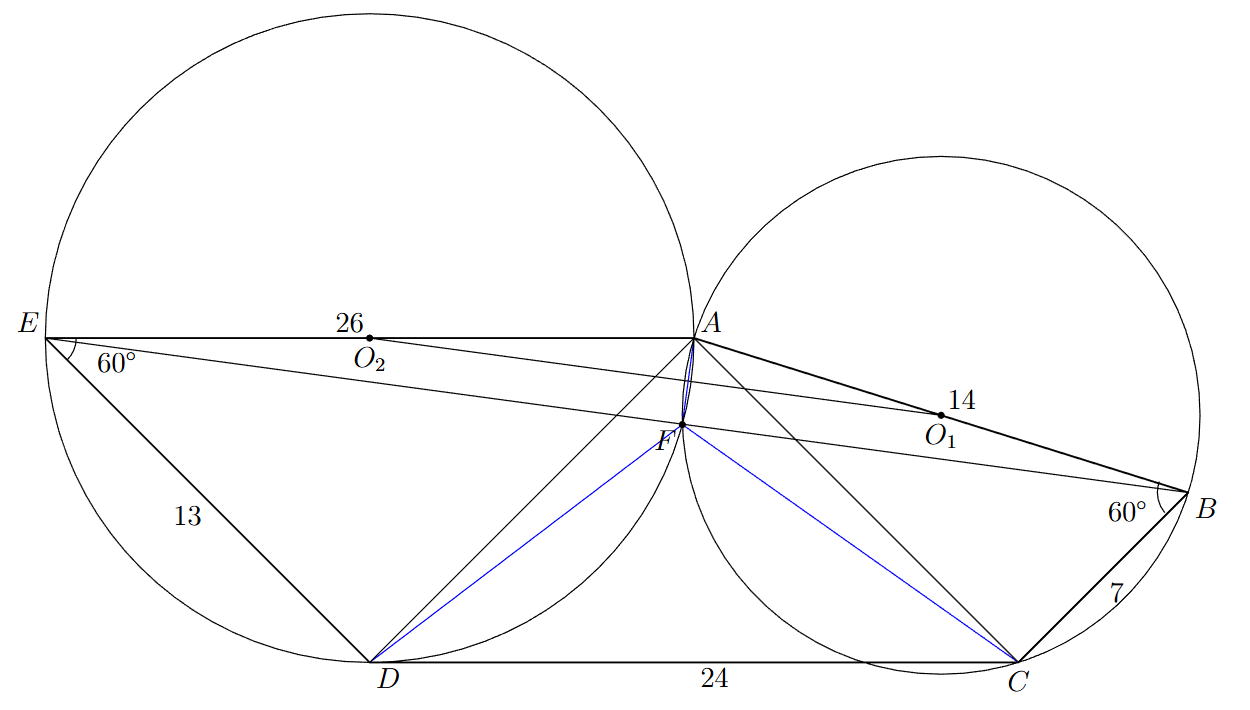
Problem:
Let ABCDE be a convex pentagon with AB=14, BC=7, CD=24, DE=13, EA=26, and ∠B=∠E=60∘. For each point X in the plane, define f(X)=AX+BX+CX+DX+EX. The least possible value of f(X) can be expressed as m+np, where m and n are positive integers and p is not divisible by the square of any prime. Find m+n+p.
Solution:
First, note that △ADE and △ACB are right 30−60−90 triangles. Therefore their circumcircles have centers on the midpoints of AE and AB respectively.
Next, consider the Fermat point F of △ACD; This is the point in △ACD where AF+CF+DF is minimized, and additionally, ∠AFD=∠DFC=∠FCA=120∘. Since ∠AFD+∠AED=180∘ and ∠AFC+∠ABC=180∘, F lies on both circles and is the other intersection point of the two circles.
We also have that O1O2 bisects AF and that AO1O2∼ABE by SAS similarity in a ratio of 1:2. Therefore, BE will pass through the second intersection point of the circles, namely F. Since F is a point which minimizes both BX+EX and AX+CX+DX, F minimizes AX+BX+CX+DX+EX. All that is left is for us to compute the value: We have AD=133 and AC=73. Let AF=a,DF=b, and CF=c. From Law of Cosines: