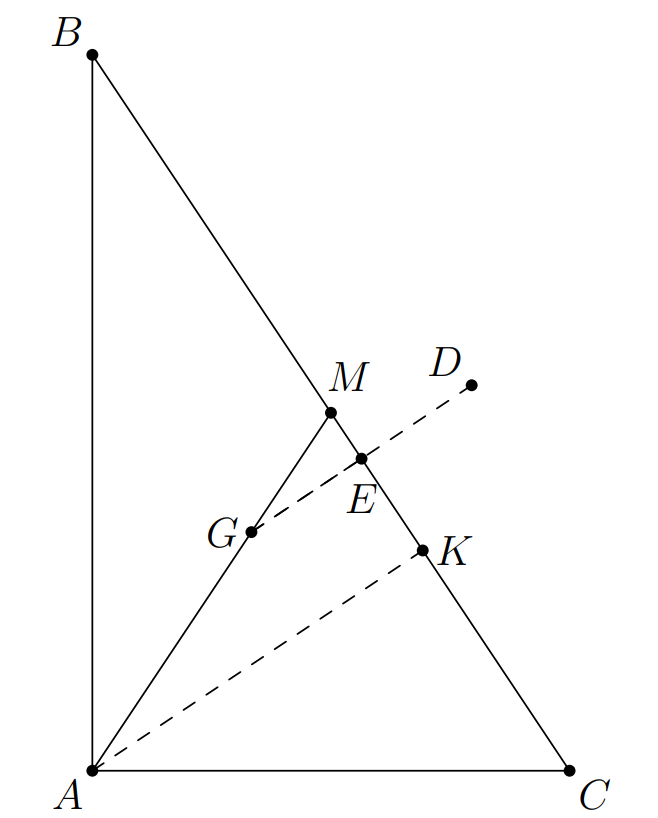
Triangle △ABC lies in plane P with AB=6, AC=4, and ∠BAC=90∘. Let D be the reflection across BC of the centroid of △ABC. Four spheres, all on the same side of P, have radii 1, 2, 3, and r and are tangent to P at points A, B, C, and D, respectively. The four spheres are also each tangent to a second plane T and are all on the same side of T. The value of r can be written as nm, where m and n are relatively prime positive integers. Find m+n.
Note that if two planes are tangent to a sphere, than the angle bisecting plane that intersects the sphere passes through the center of that sphere. Therefore if all 4 spheres are tangent to the same two planes, the centers of the 4 spheres must lie on this angle bisecting plane, so we know the 4 sphere centers are coplanar.
We assign coordinates as follows: A(0,0), B(0,6), and C(4,0) in the z=0 plane. The coordinates of G are then (30+0+4,30+6+0)=(34,2). The equation of line BC is 3x+2y−12=0, so the distance from G to BC is
32+22∣3⋅34+2⋅2−12∣=13413
The slope of the height from G to BC is then 32 as it is perpendicular to BC. A segment of length 13413 with slope 32 corresponds to a horizontal translation of 134⋅2 and a vertical translation of 134⋅3. Thus the reflection of G across BC to form D will correspond to horizontal and vertical translations of twice these distances. The final coordinates of D are then:
(34+134⋅2⋅2,2+134⋅3⋅2)=(39124,1342).
The three centers of the spheres above the points A, B, and C are (0,0,1), (0,6,2) and (4,0,3). We see that traveling in the positive y direction from A to B increases the z value by 1 over a distance of 6 units. Similarly traveling in the positive x direction from A to C increases the z value by 2 over a distance of 4. Since the z value at (0,0) is 1, the equation of the plane passing through the 3 centers is:
z=1+2x+6y
Now we plug in the point at D to get the center of the 4th circle as: (39124,1342,39122). Thus, r=39122 and m+n=161.
Define the radius r(X) for a point on the plane P as the unique radius for a sphere tangent to P at X and also tangent to T.
We claim that for any X,Y on the plane, if Z is the point on line XY with XZ:ZY=v:u (we use signed distances, so XZ and ZY have the same sign only if Z is between X and Y; alternatively if you are willing to consider vectors, Z−X:Y−Z=v:u)
r(Z)=u+v1(u⋅r(X)+v⋅r(Y))
Note that the center of this sphere C(Z) must lie on the plane of the angle bisector of P and T. If we let ℓ be the intersection of the two planes, we will have
r(Z)=distance from ℓ to Z⋅tan(angle between P and T)
a linear function of the distance from Z to ℓ. But note that by similar triangles, the distance d(Z,ℓ) from Z to ℓ is
d(Z,ℓ)=u+v1(u⋅d(X,ℓ)+v⋅d(Y,ℓ))
so multiplying by the tangent gets us the result.
Let E be the foot of the perpendicular line from G to BC, M the midpoint of BC, and K the foot of the altitude from A to BC.
Note that BC=42+62=213, so
KC=BCAC⋅AC=21316=13813
so KM=13513. Since the median is split into a 2:1 ratio, ME=31⋅KM, so