¶ 2026 AMC 10A Problem 17
Problem:
For each edge of a regular hexagon with side length , a square is constructed inside the hexagon with that edge as one of its sides. The region interior to all six squares is the interior of a smaller hexagon, shown shaded in the figure below.
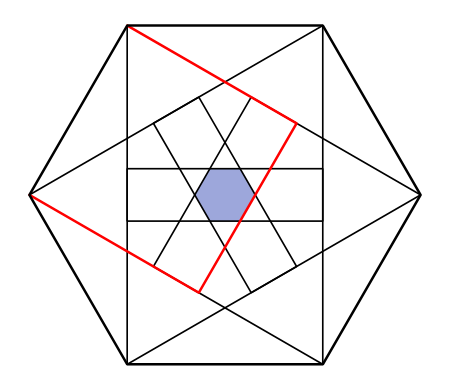
The area of the smaller hexagon can be expressed in the form , where , , , and are positive integers, and are relatively prime, and is not divisible by the square of any prime. What is ?
Answer Choices:
A.
B.
C.
D.
E.
Solution:
Let be the center of the large hexagon. Its apothem (the distance from to each side) is
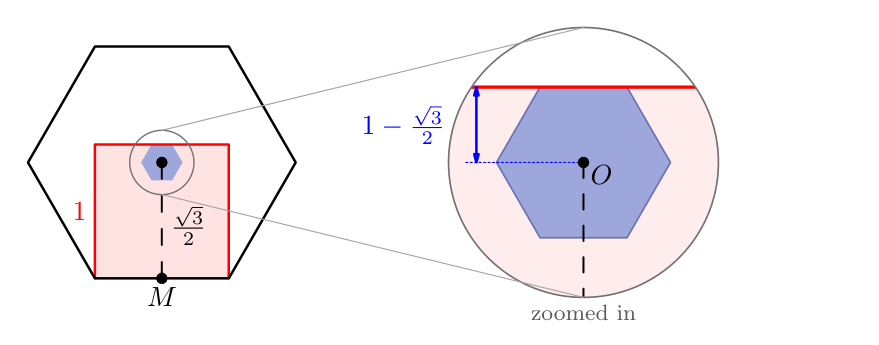
Consider the square built on one side, with the midpoint of that side. The square reaches a distance from the side, which is past the center . So the far side of the square is a line parallel to the side, on the other side of , at distance
from .
Being inside a square means (i) being within distance of its side, and (ii) lying between its two other sides, which are the lines through the endpoints perpendicular to that side, at distance from .
Doing this for all six squares, the region inside all of them is bounded by the six far sides, which form a regular hexagon centered at with apothem
This hexagon is tiny (its vertices are at distance from ), so the conditions in (ii) cut nothing off.
A regular hexagon with apothem has side and area
Here
so the area is
Thus , , , , and
The answer is .
The problems and solutions on this page are the property of the MAA's American Mathematics Competitions