Problem:
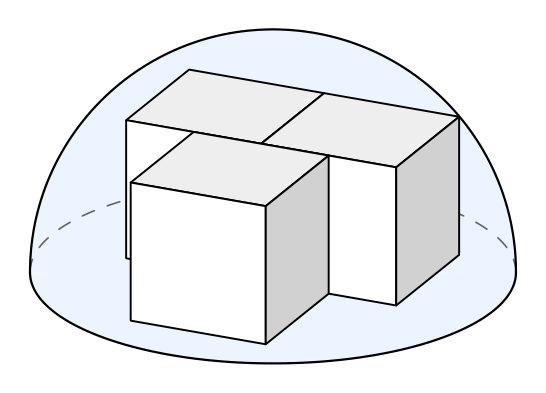
Three 2×2×2 cubes sit on a table so that two of the cubes share a face, and a face of the third cube is centered along a shared edge of the other two cubes, as shown.
A hemispherical cover is placed over the cubes so that its circumference rests on the table and the cubes are under the cover. What is the least possible value of the radius of the cover?
Answer Choices:
A. 3
B. 6357
C. 8681
D. 4178
E. 23
Solution:
Put the table in the plane z=0. The two cubes that share a face occupy
−2≤x≤2,0≤y≤2,0≤z≤2,
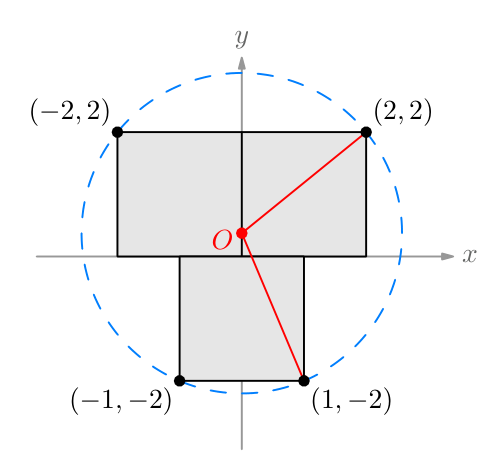
and the third cube has its back face centered on the shared edge along x=0, so it occupies
−1≤x≤1,−2≤y≤0,0≤z≤2.
The center O of the hemisphere lies on the table. A hemisphere of radius R covers the cubes exactly when every top corner of the cubes (at height z=2) is within distance R of O; the bottom corners are then automatically covered. The figure is symmetric about the plane x=0, so we may take O=(0,k,0).
The relevant top corners are (±2,2,2), (±2,0,2) and (±1,−2,2), with squared distances to O
For 0≤k≤1 the middle value is at most the first, so we must minimize the larger of 8+(2−k)2 (which decreases in k) and 5+(k+2)2 (which increases in k). The best choice makes them equal: