¶ 2026 AMC 10A Problem 22
Problem:
An engineer is designing a closely packed field of wind turbines for electricity production. Each turbine, whose center is marked by a labeled dot in the figure, occupies one of congruent elliptical regions. Turbines in the same row have centers that are units apart, and turbines in the same column have centers that are units apart, as shown in the figure below.
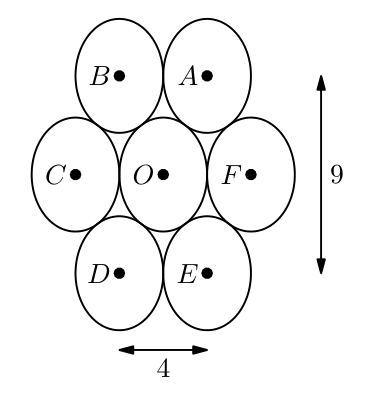
The major axis of each ellipse is , where and are positive integers and is not divisible by the square of any prime. What is ?
Answer Choices:
A.
B.
C.
D.
E.
Solution:
Let the major and minor axes of each ellipse be and , respectively. Place the central ellipse at the origin. Apply the affine transformation
Then the central ellipse maps to the unit circle. Since all turbines are congruent, every other ellipse also maps to a circle of the same radius.
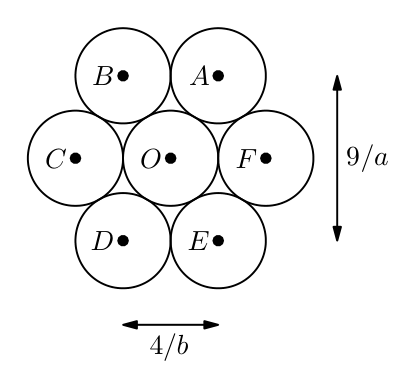
A turbine ellipse is tangent to the central one exactly when their transformed centers are units apart. Hence the six outer centers lie on a circle of radius centered at , and adjacent outer centers are also units apart. Therefore is a regular hexagon with side length .
The vertical distance between the appropriate opposite vertices and in the original plane is . Under , this vertical distance becomes . In the regular hexagon, the distance is
Thus
so the major axis is
Hence and , giving .
Remark
Students may not be familiar with the concept of an affine transformation; but everyone is familiar with the idea of a "squish." When you squish an ellipse the perfect amount, it becomes a circle. That is the key idea here.
Imagine squishing the picture horizontally by a factor of and vertically by a factor of . Then every ellipse becomes a circle. The central turbine becomes the unit circle, and every other turbine becomes a circle of the same size.
Because squishing preserves tangency (think: if I squish two curves together, they can't touch in more places than before), the six outer turbine centers must lie on a circle of radius around the center, and adjacent outer centers must be units apart. Thus they form a regular hexagon.
Now look at the vertical distance in the original picture. After squishing vertically by , this distance becomes . In the regular hexagon, the corresponding vertical distance between opposite vertices is , so
Thus the major axis is
Hence and , giving .
The problems and solutions on this page are the property of the MAA's American Mathematics Competitions