¶ 2026 AMC 10A Problem 6
Problem:
A triangle with sides , , and is inscribed in a circle, dividing the interior of the circle into four regions. Let , , and be the areas of the non-triangular regions, with being the greatest. What is the value of ?
Answer Choices:
A.
B.
C.
D.
E.
Solution:
Note that
so the triangle is a right triangle with hypotenuse (it is the -- triangle scaled by ).
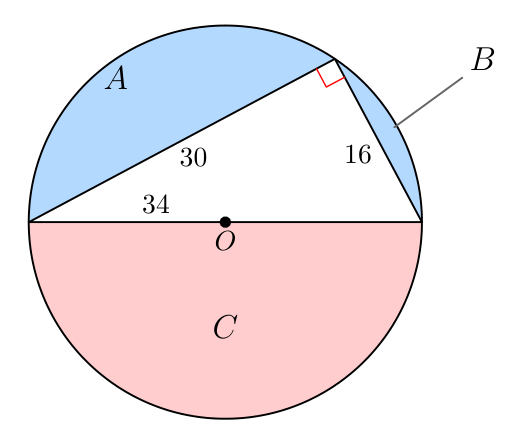
An inscribed right angle subtends a semicircle, so the hypotenuse is a diameter of the circle. The radius is and the area of the circle is .
The diameter splits the disk into two semicircles of area each.
- The semicircle on the side away from the triangle is one whole region, so .
- The other semicircle consists of the triangle together with the two regions cut off by the legs, and .
The triangle has area , so
(Indeed is the greatest region, since .)
The problems and solutions on this page are the property of the MAA's American Mathematics Competitions