¶ 2026 AMC 10B Problem 25
Problem:
Rectangular card has and . As shown in the figure, a second card, , congruent to the first, is stacked onto it so that lies on and the two cards share corner .
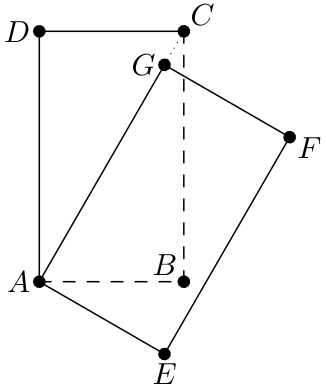
Additional cards are added, following the same pattern (with shared corner ), creating a fan of cards. The process stops when a new card fits exactly atop . The shape then created is a nonconvex polygon with rotational symmetry. What is the area of this polygon?
Answer Choices:
A.
B.
C.
D.
E.
Solution:
The fan. Since and , triangle is a 30-60-90 triangle: and , so . Placing (a long side) along turns the card by about . Each new card turns another , so after 12 cards the next card lands exactly on , and the polygon is the union of 12 cards, each turned from the previous one.
Coordinates. Put , and . The second card's far corner is (that is, turned clockwise), and its long side lies on a line at distance from . Between and , the boundary of the fan runs down the side of the first card until it meets at a point , then along to .
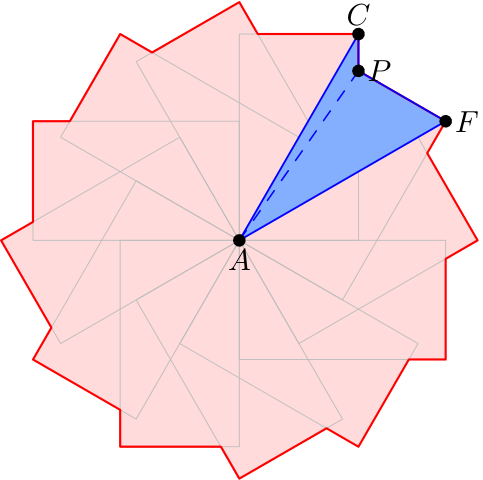
With , the segment has slope , so on the line it is at height
One twelfth of the polygon. By the 12-fold symmetry, the polygon consists of 12 copies of quadrilateral (shaded blue). Split it along :
- has base on the line , and height 1 from . Its area is .
- has base on line and height from . Since and (the horizontal run divided by ), we get . Its area is .
So , and the area of the polygon is
The problems and solutions on this page are the property of the MAA's American Mathematics Competitions