Problem:
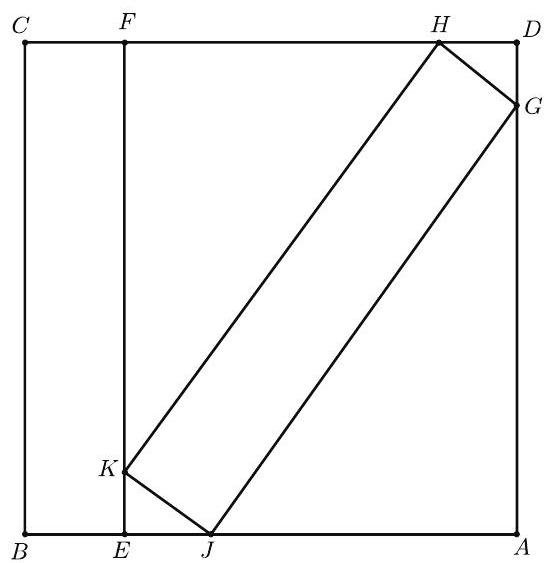
In the figure, ABCD is a square of side length 1 . The rectangles JKHG and EBCF are congruent. What is BE ?
Answer Choices:
A. 21(6−2)
B. 41
C. 2−3
D. 63
E. 1−22 Solution:
Let x=BE=GH=CF, and let θ=∠DHG=∠AGJ=∠FKH. Note that AD=GJ=HK=1. In right triangle GDH,xsinθ=DG=1−AG=1−cosθ, so x=sinθ1−cosθ. Then 1=CD=CF+FH+HD=x+sinθ+xcosθ. Substituting for x gives
Let a=EK,b=EJ, and c=JK=BE. Then triangles KEJ,GDH, and JAG are similar right triangles and it follows that a2+b2=c2,ca=1−b−c, and cb=1−a. The first equation is equivalent to a2=(c+b)(c−b), and the last equation is equivalent to ac=c−b. Multiplying by c+b and equating to the first equation gives ac(c+b)=(c+b)(c−b)=a2. Because a>0, it follows that a=c(c+b). Plugging into the second equation gives c(1−b−c)=c(c+b). Because c>0, it follows that c+b=21. Thus a=2c and
c2=a2+b2=4c2+(21−c)2
Solving for c gives c=2±3. If c=2+3, then b=21−c=−23−3<0. Thus BE=c=2−3.