Problem:
Let △ABC be a scalene triangle with incenter I. (Recall that the incenter is the intersection of the three angle bisectors.) The distances from I to the midpoints of the sides of △ABC are 11, 14, and 19. What is the sum of the possible areas of the circle inscribed in △ABC?
Answer Choices:
A. 10π
B. 344π
C. 358π
D. 388π
E. 30π
Solution:
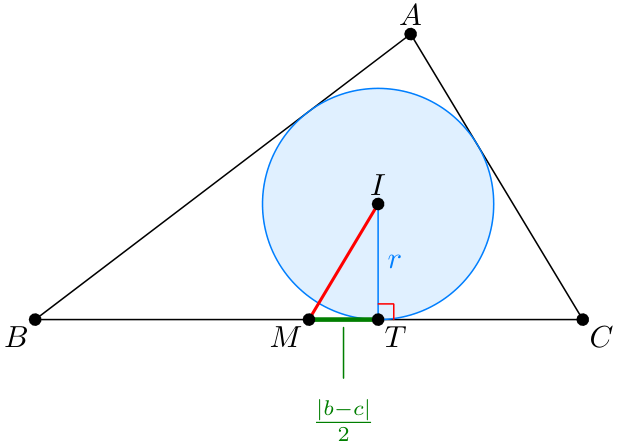
Let the sides be a=BC, b=CA, c=AB, the semiperimeter s, and the inradius r.
Distance from I to a midpoint. The incircle touches BC at T with BT=s−b, while the midpoint M of BC has BM=2a. So
TM=∣∣∣∣2a−(s−b)∣∣∣∣=2∣b−c∣.
Since IT⊥BC and IT=r,
IM2=r2+4(b−c)2.
The same holds for the other two sides with ∣c−a∣ and ∣a−b∣.
Setting up. Let d1≤d2≤d3 be the three positive differences ∣b−c∣, ∣c−a∣, ∣a−b∣ in increasing order. A larger difference gives a larger distance, so with u=r2,
d1=211−u,d2=214−u,d3=219−u.
If the sides are ordered x<y<z, the differences are y−x, z−y and z−x=(y−x)+(z−y), so the largest difference is the sum of the other two:
The root u=358 is extraneous: it is larger than 11, so 11−u would not be real. Hence u=r2=10, which gives differences 2,4,6.
Such triangles exist. Two side patterns have these differences, (x,x+2,x+6) and (x,x+4,x+6). As x grows from the smallest value allowed by the triangle inequality, the inradius grows continuously from 0 without bound, so each pattern has a scalene triangle with r2=10. Both give the same incircle.
So the only possible area of the incircle is πr2=(A)10π.
Watch out. Keeping the extraneous root as well would give 10π+358π=388π, which is choice (D).